Sunday, 8 July 2012

The British Royal Family and The Automobile - Picture Gallery


The Queen found the practical benefits of a large estate car very appealing. Her Majesty's Ford Zephyr was a popular choice, often used around the grounds of the Sandringham estate  
To mark the Queen's Diamond Jubilee, The Cartier lawn at the 2012 Goodwood Festival of Speed saw an extensive collection of vehicles used by members of the Royal Family. The collection were categorised into groups including Royal Working Vehicles, State Vehicles and Cars used Overseas amongst others. The cars themselves were owned either by Her Majesty, the wider Royal Family, museums or by governments. It was a great spectacle and interesting to read the stories of how each model played a role in the private and public lives of the Windsor's. Enjoy...

This Ford V8 Pilot was bought by King George VI shortly before his death in 1952. He didn't have much time to enjoy it but the car was bespoke; the chassis was 12 inches longer than normal

This Humber Super Snipe had come back from Australia - the car still had its New South Wales registration attached. The car was used on the Queen's first Commonwealth tour
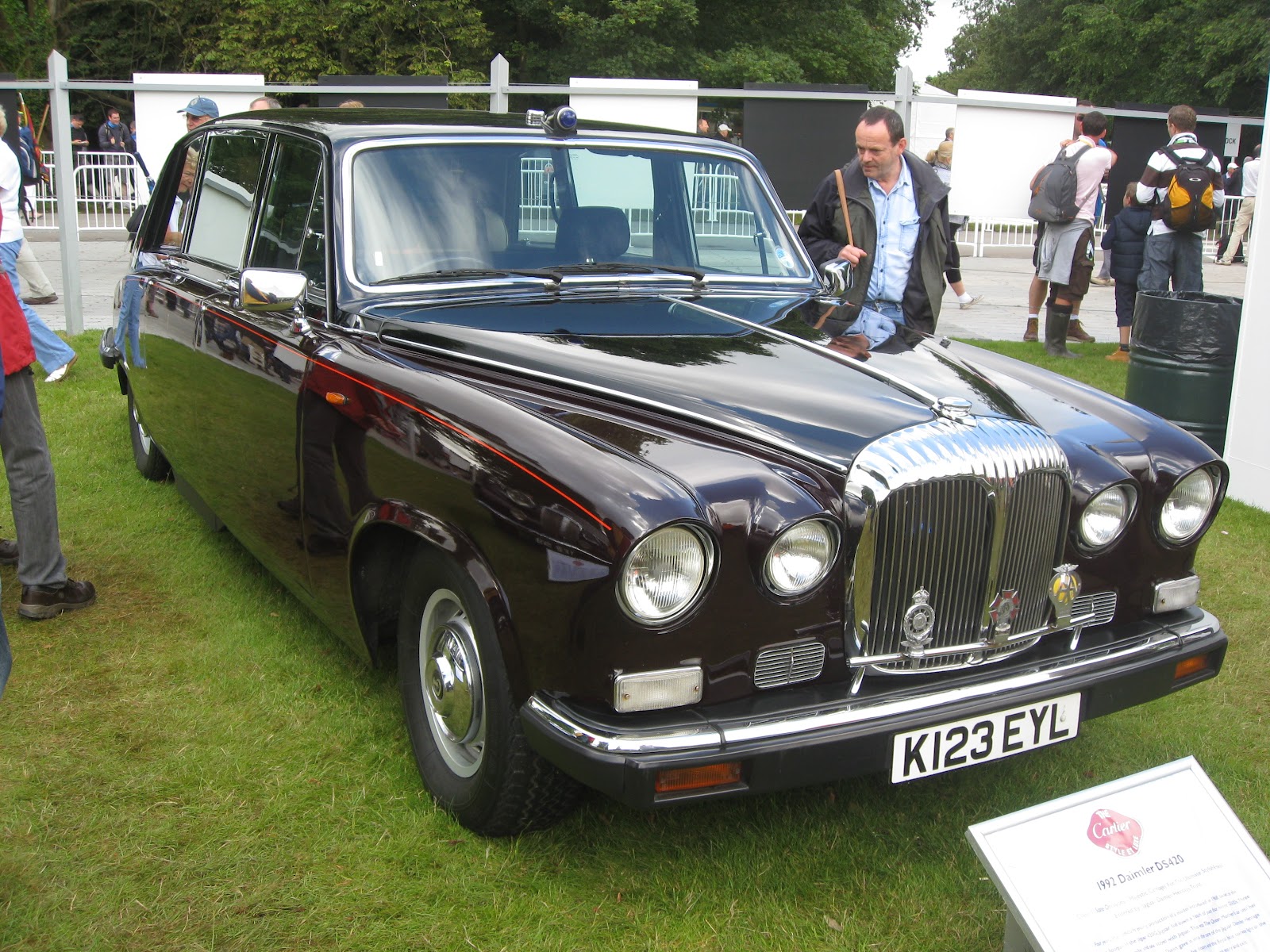
This Daimler DS420 4.2 Automatic became a favourite of the Queen Mother. The limousine's extras included flashing lights set behind the radiator grille and a powered step to help her into the car. Her crest can be found on the rear doors
This 1950 Lincoln Cosmopolitan 'Bubbletop' was owned by the US Secret Service and can normally be found today in Ford's museum in Detroit, Michigan. The Queen used it while on a visit to the White House in 1957
This Daimler Super Sport was for a time The Queen's personal set of wheels, often used around the Sandringham estate. Jaguar made some alterations as requested by Her Majesty including an enlarged centre storage compartment. Her handbag had to fit somewhere! 
Prince Philip ordered this 1961 Alvis TD21 SII Drophead Coupe which became one of his favourites. Alterations were carried out by Mulliner Park Ward - the Prince requested that the usual shiny wooden dashboard be replaced with a leather alternative
The Queen rode in this Citroen SM Decapotable during her official state visit to France in 1972. The car was officially signed off for release by former French president Nicolas Sarkozy
The Queen has always been a fan of the traditional Land Rover Defender - they are particularly welcome in Balmoral. One of her older models has seen extensive service over many years in the Sandringham estate covering over 40,000 miles. This model was presented to the Queen at the turn of the Millennium and featured an automatic transmission. It wasn't long before she missed a manual and it was sent back to have one fitted  
This 1969 Austin Princess 4.0 Vanden Plas limousine was a Royal state working vehicle for many years. It was in this car that a kidnap attempt was made whilst Princess Anne was being driven along The Mall after a public engagement in 1974. Ian Ball, a 24 year old man with mental health problems ambushed the motorcade and shot two royal protection officers and ordered Princess Anne to give him £2m. The Princess Royal apparently responded with "Not bloody likely, and I haven't got £2m"
This Vauxhall Cresta Friary estate served a very similar role to the Ford Zephyr mentioned earlier. Vauxhall never officially launched an estate version of the Cresta saloon - the models were sent to Friary Motors of Basingstoke to be converted
Like all Royal state vehicles, this Rolls Royce Phantom V doesn't require to be registered, hence no plates. This model was normally kept aboard the Royal Yacht Britannia to be used around the world on official state visits. The bonnet of this Rolls Royce has been shortened in order for it to fit on the decks of the royal yacht
The Royal toy car collection! Some are pedal powered whilst others use either battery or petrol propulsion. The collection included a 1924 Citroen C4, a 1950 Austin J40, a 1966 Aston Martin DB5 007 replica presented to a young Prince Andrew and a 1988 Aston Martin Volante given to Prince Charles when he visited Aston's Newport Pagnell works. The American Imperial Midget racer was given to Prince Charles when he was a boy and could reach well over 30mph. The caravan was presented to a young Prince Charles and Princess Anne by the Caravan Club in 1955 - Prince Philip reportedly used his Hillman Husky to tow them around Sandringham    
This 1991 Daimler Double Six Series 3 was used by The Queen for private functions. It was painted a unique colour as requested by Her Majesty whilst the standard rear seatbelts were replaced with more dignified lap belts. The car ended up in private hands, the owner only later finding out who the previous keeper was! 
Mercedes have always owned this 600 Pullman and it was regularly used by the German government for state occasions. The Queen used it during an official visit to West Germany. The rear section of the roof can be removed so onlookers can have a clearer view of the VIPs

Thursday, 10 May 2012

Nuffield Place

Nuffield Place is located near to Henley-on-Thames and was the home to William Morris; later Lord Nuffield
2012 saw the doors open to the home of one of the world's most influential automotive pioneers; William Morris, the founder of Morris Motors.
Being such a car enthusiast as well as someone who finds the history of the British motor industry a constant interest, a visit to Nuffield Place was a must. Opened up by the National Trust, I can report that the house is well worth a visit. I just hope the weather will be kinder to you than it was to me!
William Morris was born in 1877 and was a keen cyclist in his youth winning various trophies. After leaving school, Morris had ideas of becoming a doctor, although due to the expense of entering the profession, Morris instead started work in a bicycle repair shop. He soon branched out by setting up his own business at the family home repairing push bikes and soon after set up his own purpose built shop in Oxford that repaired bicycles and began manufacturing them.
It wasn't long until Morris moved to petrol power and designed the Morris Motor Cycle in 1901 at the age of 24. By 1912, (the same year the Titanic sank) Morris designed his first car, the 'Bullnose Morris' and production kicked off in Cowley.
The outbreak of the First World War halted progress and Morris turned to making munitions in the car factory as part of the war effort. Car production started again in 1919 and it is from then that things really started to take off. A production run of 400 cars were built in that year but by 1925 the figure had risen to 56,000. Morris was well aware of the effective production line and mass production processes pioneered by Henry Ford.
One of the lounges in Nuffield Place. Nothing in the house has been altered since the days when it was the home of Lord and Lady Nuffield 
Morris Motors had tough competition from Herbert Austin and both were producing cars that could be bought by an ever growing number of middle class customers. The Austin Seven in particular was a runaway success.
In a bid to keep Austin in check, Morris bought the bankrupt Wolseley Motors. Thanks to a nearly finished advanced engine design, he slotted this into the new Morris Minor of 1928. Morris also produced sportier versions of their standard cars under the MG name, (Morris Garages); a brand that was started up by an employee at Morris, Cecil Kimber. Morris also bought Riley Motors from the Riley family. Morris Motors were at this time in a very strong position although the outbreak of the Second World War again halted progress. Morris turned his focus again on manufacturing munitions.
Following the war, Morris merged with Austin in 1952 to form BMC, (British Motor Corporation) and William Morris become director.
Morris oversaw a number of key designs in his time from the early Bullnose Morris and Morris Minor to the Issigonis designed Morris 1000 Minor of 1948. The BMC developed Morris 'Mini' Minor/Austin Seven of 1959 and the Morris/Austin 1100 were other huge successes that Lord Nuffield was involved with.
Although Lord Nuffield died in 1963, the Morris brand continued for many years after his death. The BMC became British Motor Holdings in 1966 when it bought out Jaguar and shortly after this, the majority of the British motor industry became 'one' as British Leyland. I expect Lord Nuffield would have been rather upset to see the demise of the once powerful British motor industry, mainly thanks to unions, strikes and mismanagement during the 1970's British Leyland saga. The last Morris badged car was the Marina based Ital, the final model of which rolled off the Longbridge production line in 1984.
Naturally Lord Nuffield was a keen inventor. This is his take on an exercise bike that he made using car parts. It's located in his games room that also includes a large billiards table 
It was fascinating walking through his home that he shared with his wife until the end of their days. When Lord Nuffield died in 1963, the estate was left to the Nuffield College in Oxford who only recently passed it onto the National Trust. Although the house has been tended to for all of these years, nobody has lived in it since Lord Nuffield's death and so it's like stepping into a time warp - nothing has been removed or altered since.
Although Nuffield Place is a nice enough home with some pretty gardens, it's clear that Lord Nuffield was never extravagant with his money and never worried about material possessions. Although he was one of the richest men in the world, he always appeared to live thriftily and made it clear that his drive was not to increase his own personal wealth, but to see how far he could get. The only relatively expensive antiques in Nuffield Place are four grandfather clocks, all located in the downstairs hallway.
In later years, Lord Nuffield tired of the English winters and so often spent his time in Australia. These were his only notable expenditures. Even as far as his own personal transport was concerned, he had an identical Wolseley saloon to his wife's - her car can be seen in the garage at Nuffield Place. His can be seen at the British Motor Museum in Gaydon.
An example of a Morris built Iron Lung, a rather intimidating looking device but a very important instrument for the treatment of polio
Lord and Lady Nuffield never had any children and so much of Lord Nuffield's fortune was given to worthy causes - he was known as a great philanthropist. He gave £50,000 to expand the Sea Cadets Corp of the UK and founded the Nuffield Foundation with a endowment of £10 million in order to increase education and social welfare for others less fortunate. He also founded the Nuffield College in Oxford as well as giving money to medical institutions. He even set aside space in his car factories for the manufacture of the Iron Lung to help with the fight against polio. His previous interest in the medical profession was evident in his later life - he even kept his appendix after removal which can be seen in a jar in his bedroom!
I came away from Nuffield Place with a much bigger understanding of what William Morris aka Lord Nuffield was like as a person. Although shy, he was very much an enterprising, kind and generous man who gave much to this country. Well worth a visit...

Monday, 9 April 2012

Dreaming of a new Triumph?

This was the last Triumph 2000 series off the line; a 1977 2500S estate
As far as British car marques of yesteryear are concerned, Triumph has to be one of my favourites. Many were sporty, plenty were good looking, (having been styled by Michelotti) and most were pretty cool.
Favourites of mine? They'd have to include the six-cylinder Herald Vitesse, the Stag, TR6 and Dolomite Sprint. I even have fond memories of Triumph's last car; the Acclaim. Although effectively a Honda and not in any way sporty, I remember being taken out in one owned by my grandparents.
It's well known that Triumph suffered from reliability issues and inner-house rivalry as part of the British Leyland empire. Like many BL brands, Triumph suffered as a result. Funnily enough, the Acclaim was actually very reliable, even though it lacked the passion and character that a lot of the brand's earlier models had in spades. The last Triumph rolled off the Cowley production lines in 1984.
BMW currently own the rights to the Triumph marque. The Bavarian manufacturer acquired the name at the same time it bought the Rover Group from British Aerospace in 1994.
It came to light in 2012 that BMW had rather quietly applied for a European trademark in order to use Triumph's laurel wreath badge. It's still unclear as to what BMW's plans were for taking this action. There were rumours that BMW were thinking of introducing a slightly cheaper and lower powered range of sports cars based on BMW underpinnings.

Triumph TR6
Of course, BMW applying for a trademark doesn't necessarily mean producing a new Triumph was a serious consideration. They could have merely been protecting their ownership of the brand or maybe were just considering selling some branded Triumph accessories. It's an interesting thought though...
Certainly Triumph has a lot of brand kudos. Triumph sports cars, (in particular the TR series) were very well received and sold healthily in the US as well as Britain. The allure of owning a modern day Triumph roadster which offers simple and rewarding driving thrills maybe hard for many to resist, myself included...
Would anyone out there like to see a modern day Triumph? If so, what model would you most like to see reinterpreted?...